Current mechanical switch technology does not exist in a vacuum. It is the result of decades of engineering iteration, driven by the need for reliable human-computer interfacing. Understanding the historical context reveals why the Cherry MX footprint became the universal standard, and why operators still seek out vintage hardware.
The Golden Age: IBM and the Buckling Spring
In the 1980s, keyboards were not budget peripherals; they were integral, expensive components of mainframe terminals. The pinnacle of this era was the IBM Model M, utilizing the patented "buckling spring" mechanism. Unlike modern stem-and-leaf switches, the buckling spring relies on a large coiled spring that physically buckles (bends and collapses) under pressure, striking a membrane contact below.
This design provided unparalleled tactile feedback and a loud, metallic acoustic report. It was engineered to mimic the feel of an electric typewriter, ensuring operators transitioning to digital terminals maintained their typing speed without bottoming out violently. While objectively excellent, the mechanism was bulky, complex, and expensive to manufacture, leading to its eventual decline in mass-market hardware.
The Japanese Challenger: Alps Electric
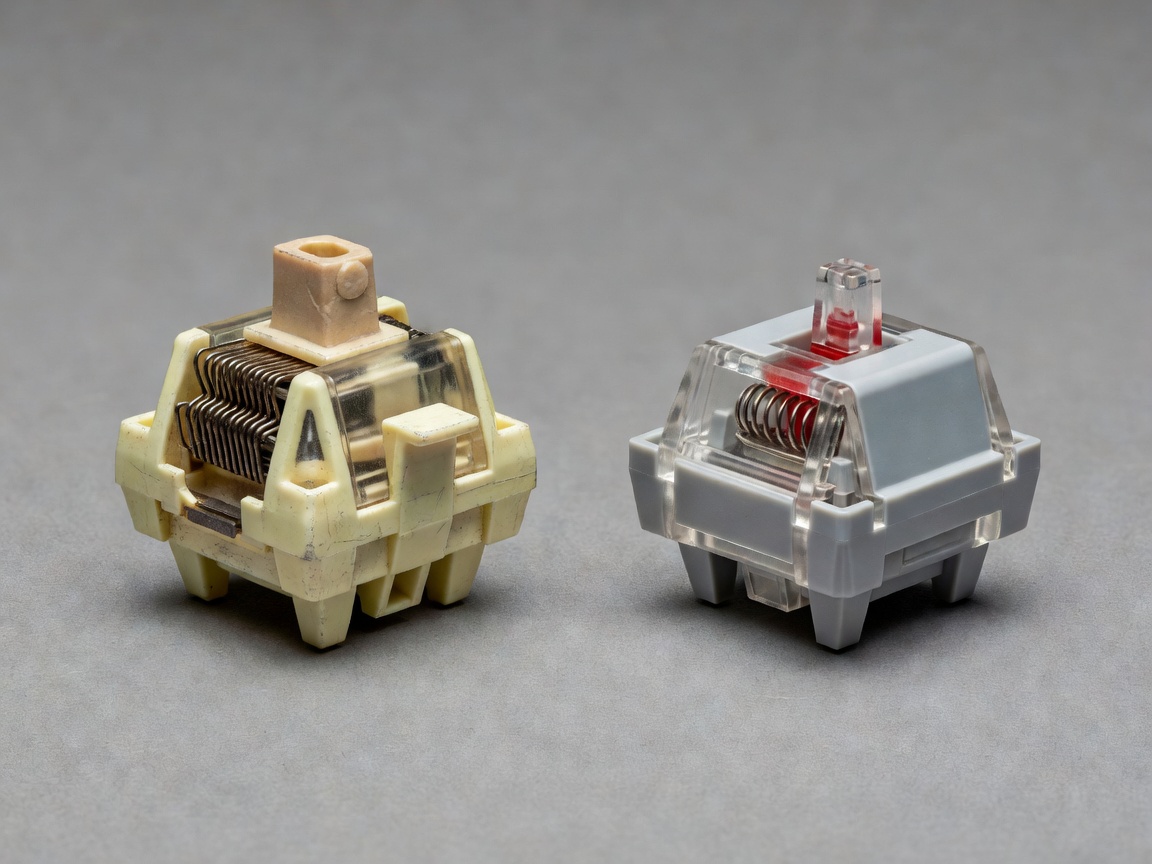
Concurrent with IBM's dominance, Japanese manufacturer Alps Electric produced the SKCM/SKCL series of switches. Alps switches utilized a wide, rectangular slider and a highly complex internal leaf mechanism. The Alps SKCM Blue and SKCM Orange are still considered by many field experts to offer the finest tactility and click ever achieved in a keyboard.
However, Alps switches were highly susceptible to dust ingress. A dirty Alps switch becomes drastically scratchy and binds during travel. Furthermore, the massive size of the switch limited keyboard design miniaturization. Alps eventually ceased production of complex mechanical switches in the late 1990s.
The Consolidation: Cherry MX Dominance
Introduced in 1983, the Cherry MX architecture offered a compromise. It was less tactile than an Alps switch and less robust than a buckling spring, but it was self-contained, relatively dust-resistant, easily soldered to PCBs, and cheaper to produce in volume. Crucially, the cross-shaped stem became a brilliant standardization vector, allowing universally interchangeable keycaps.
For two decades, Cherry held a virtual monopoly on mechanical switches. It wasn't until the expiration of the MX patent in 2014 that the market fractured. This allowed Chinese manufacturers like Gateron and Kailh to legally clone the MX housing while experimenting with new materials, spring weights, and contact mechanisms.
The Electro-Capacitive Anomaly: Topre
No historical briefing is complete without mentioning Topre. Developed in Japan, Topre switches are not purely mechanical; they are electro-capacitive. A rubber dome provides the tactile collapse, but rather than pushing a physical metal contact, a conical spring beneath the dome alters capacitance on the PCB to register a keystroke. Topre is celebrated for its unique, rounded tactility and deep, muted sound (colloquially described as "raindrops"). It remains an isolated, expensive, and highly coveted alternative to the MX standard.