Theoretical knowledge must be mapped to real-world entities. The market is saturated with options, but intelligence gathering reveals three primary tiers of manufacturers: The standard-bearer (Cherry), the mass-market challengers (Gateron, Kailh), and the boutique foundries (JWK, Tecsee, Durock). This file provides a direct comparative analysis.
The Standard: Cherry GmbH
Based in Germany, Cherry is the architect of the MX design, the patent for which expired in 2014, opening the floodgates for clones. Cherry's primary operational advantage is extreme durability and strict tooling tolerances. A Cherry MX switch is rated for 100 million actuations without failure. However, their standard nylon/PC housings are notorious for a scratchy travel out-of-the-box compared to modern competitors. The Cherry MX Black (particularly vintage variants) remains a highly sought-after linear switch when heavily lubricated.
The Challenger: Gateron
Gateron established itself initially as a cheaper Cherry clone, but quickly surpassed the original in out-of-the-box smoothness. Their stems are molded with plastics that yield lower friction coefficients. Gateron dominates the mid-to-high end linear market with their "Ink" series (specifically Black Inks) and their KS-3 standard models. Furthermore, Gateron is leading the current shift toward magnetic Hall-effect switches for variable actuation gaming boards.
The Innovator: Kailh (Kaihua)
Kailh refused to simply clone the MX design. While they produce MX-compatible stems, their internal architectures often differ wildly. They invented the "Box" architecture, which encases the contact leaf in a plastic shroud, rendering the switch IP56 dust and water resistant. More importantly, they engineered the "Click Bar" mechanism (found in Kailh Box Jades and Whites), which produces a vastly superior, crisper click sound compared to Cherry's legacy click-jacket design.
The Boutique Foundries
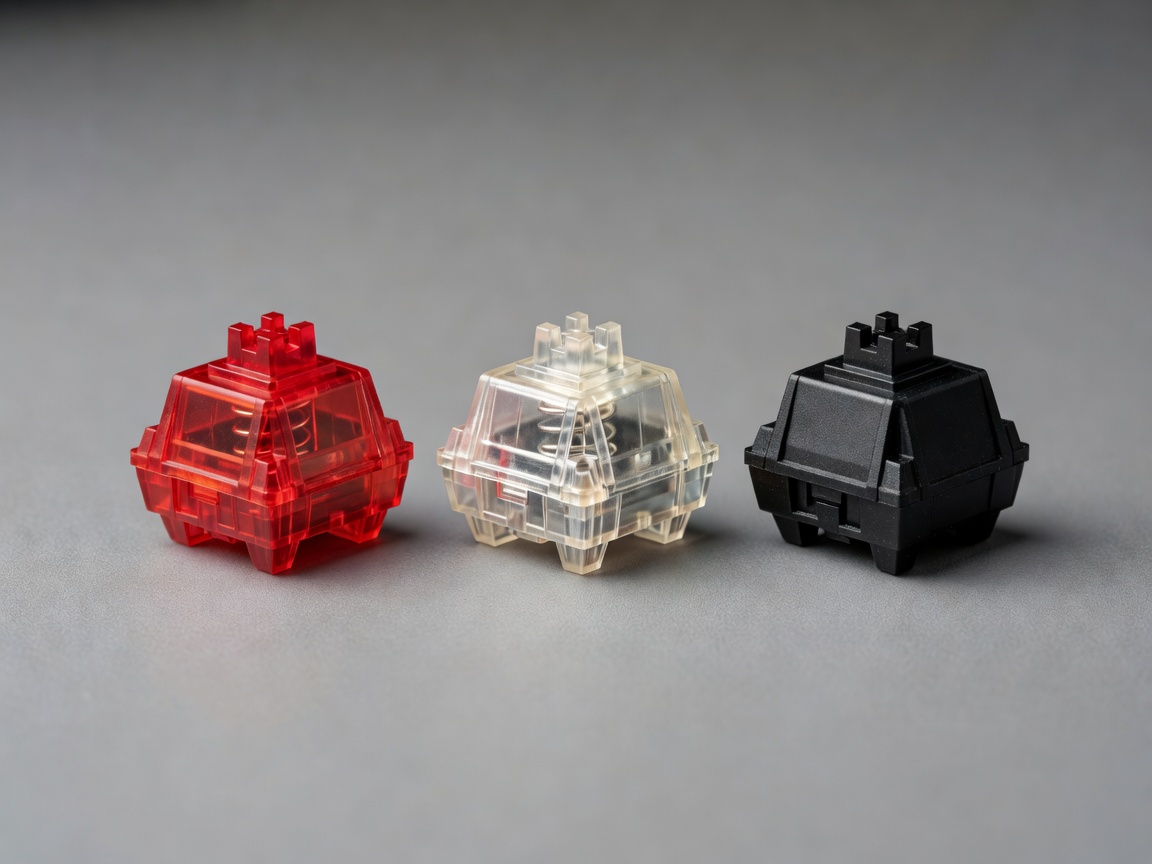
In recent years, the enthusiast community has demanded hyper-specific configurations. Entities like JWK (Jiancai) and Tecsee do not sell mass-market keyboards; they manufacture custom switches commissioned by independent designers. These switches often feature exotic polymer blends (like UHMWPE stems), complex dual-stage gold-plated springs, and factory-applied lubrication.
Comparative Matrix (Linear Class)
| Entity (Model) | Housing / Stem | Friction (Unlubed) | Acoustic Profile |
|---|---|---|---|
| Cherry MX Black | Nylon / POM | High (Scratchy) | Deep, muted (Thock) |
| Gateron Black Ink V2 | Proprietary Ink / POM | Low (Smooth) | Mid-pitch, solid |
| JWK Alpaca V2 | PC+Nylon / POM | Very Low | High-pitch, sharp (Clack) |
| Tecsee Ice Candy | Full PC / PC | Low | Very high-pitch, thin |
Conclusion: For operators requiring unyielding reliability, Cherry remains viable. For off-the-shelf smoothness, Gateron is the baseline. For specialized acoustic requirements and hyper-optimized travel paths, boutique JWK or Tecsee commissions are mandatory.